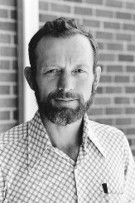
It’s been 45 years since the night three masked men broke into the rectory of Father Stanley Rother. Rather than go quietly, the 46-year-old priest fought back, but his effort was no match for two bullets. He was shot to death. The assassins were never caught. That was July 28, 1981. His death brought a terrible grief to the parishioners of Saint James (Santiago), whose lives had been changed and given hope by the missionary efforts of an Oklahoma farm boy. Upon hearing that his body would be sent back for burial, they had a request: “Let his heart remain with us.”
And so it happened. The priest’s body was sent back to Oklahoma, except for his heart which was removed and placed in a glass jar in an alcove. This shepherd would keep his promise to remain with his flock. Its presence became the focus of many prayers in the village of Santiago Atitlan, Guatemala.
That may sound macabre to modern folks, but in the nearly 2,000-year history of the Catholic Church, it was not unknown. Relics are important.
I am skipping his biography – not because it is unimportant, but – because I want to encourage you to see the feature length documentary, “American Martyr: The Stanley Rother Story” which is showing this week on Tuesday, Wednesday and Thursday at various theatres. (In Fort Smith, it will show at 7 p.m. each evening at the Malco Fort Smith).
I do wish to tell is what happened on the 10th anniversary of his death when three bishops, in Santiago Atitlan to commemorate his sacrifice, opened the glass jar.
His heart had not decayed. It was as if no time at all had elapsed.
“His heart is still liquid!” one of the bishops shouted to the crowd gathered outside. A large crowd of witnesses was stunned for a moment, and then cried for joy.
I know this to be true, for I was there.
* * *
I was the editor of The Eastern Oklahoma Catholic, at that time a bi-weekly newspaper for the Diocese of Tulsa. I worked directly for the Most Rev. Eusebius Beltran, the second Bishop of Tulsa. I was thrilled to be invited on the trip to Guatemala to chronicle the 10-year anniversary. We spent ten days in this beautiful Central American country. Our first night was in Guatemala City, the capital, in a very American-style hotel.
That night, guerrilla fighters blew up an electrical substation somewhere near the capital, and the power went out for several hours. The drawn-out civil war between the Guatemalan government and leftist guerillas had not ended and it did not bring out the best of either side. There were atrocities committed, each side blaming the other for the violence and mayhem. We were aware of this before we left the U.S. but we were assured that the country had calmed enough for us to safely visit.
Our arrival belied that assurance. Upon our arrival at the airport, we were met by young men wielding automatic rifles (machine guns), who escorted us to Customs for processing. It was unnerving, but I chalked it up to a “safety first” policy. The explosion and power outage later that night rattled our nerves, and the newspapers in the morning, though in Spanish, left more doubts. Our group could talk of little else as we prepared to board a chartered bus after breakfast.
There were two groups of pilgrims, one from Tulsa and another led by Archbishop Charles Salatka of Oklahoma City. We would worship together in Santiago Atitlan but otherwise had parallel travel plans. The Tulsa bus took us on a “scenic route” to the resort town of Panajachel, but first we would visit Antigua, (it means antique, or old), which from 1543 to 1773 was the capital city.
Later that afternoon we would wind down the mountainous highway into Panajachel, staying at a beautiful, tranquil inn that would be our home base for several days. This was on the north side of Lake Atitlan. The following morning we took a large 45-minute ferry ride south across the lake to Santiago Atitlan.
A Land of Volcanoes
The views were enthralling. Lake Atitlan is ringed by mountains, three of them volcanoes. What’s more, the lake itself fits inside a caldera not quite a mile above sea level. It’s 1,120 feet deep – the deepest lake in Central America. It was formed 84,000 years ago when Los Chocoyos volcano erupted. Two rivers keep it filled. It’s good for fishing, and that helps provide protein for the Mayan people. Local fishermen used crude wooden john boats to ply their trade.
Upon our arrival we were swarmed by dozens of welcomers, all speaking Spanish and many eager to sell us blankets, jackets, jewelry and such. It was my first experience at “haggling” and I was not very good at it. The locals seemed disappointed with my pitiful skills. A couple of people who had been there before attempted to instruct me in the local rules of commerce. It helped, but my American shopping reflexes (used to price tags and paying whatever the merchant demands) did not want to be easily put aside.
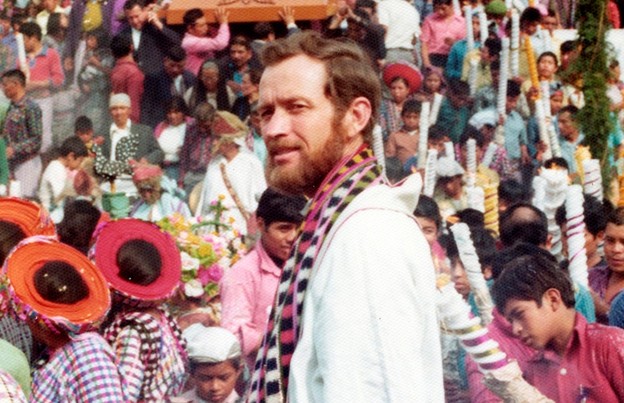
The first order of business was a tour of the Church of Santiago (St. James), meeting with Father Thomas McSherry, the replacement missionary priest from Oklahoma, and then the Oklahoma bishops met with the local ordinary, Bishop Eduardo Fuentes of the Diocese of Solola to plan the next day’s 10th anniversary Mass. The rest of us wandered about the city, admiring the cobblestone streets and the bustling mercantile district. I had my Pentax 35mm camera clicking non-stop.
The next day, July 28, would occasion a celebration Mass at the Church of Santiago. But before that we gathered near the rectory. The three bishops entered that special area set aside for Father Rother’s heart and were in there for several minutes.
When they emerged, the announcement was made. Father Stanley’s heart was still liquid. Pliable, lifelike. From a scientifical point of view, quite impossible. The jar was not hermetically sealed. It was not refrigerated. There was no embalming. The heart had been fair game for bacteria and the vagaries of highland humidity for years.
The Catholic perspective on this? Father Stan Rother’s remains were exhibiting special signs of God’s grace, of sanctity. Already considered a martyr because he knew he was on a “death list” and yet refused to abandon his flock, there was now a heaven-sent affirmation of his martyrdom.
In other words, he might well be a saint.
A Brief Explanation of Sainthood
What is a saint?
If you are Christian, it’s what you dearly wish to be. A saint is someone who has attained Heaven, who lives forever in the friendship of Christ, who enjoys the “beatific vision,” and who rejoices in communion with all the other saints and angels who populate this region of God’s Kingdom. In fact, it should be your goal in life to become a saint, and to help your family members become saints.
There are countless saints. Scripture says they are beyond numbering (Revelation 7:9). They represent all those saved throughout the centuries. We don’t know most of their names.
But some are known, given as examples to inspire us and to offer help to us. The Roman Catholic Church does not make snap judgments as to who merits sainthood; in fact, it is extremely plodding in its deliberation of sainthood “causes”. There are procedures for such things and it usually takes decades for sainthood to be declared. Even with martyrdom, the Church prefers to validate a miracle or two, to establish proof that the would-be saint, with the approval of Almighty God, has interceded for someone on earth. That a miracle has taken place.
The process of naming saints is not really meant for those who have died. They already know who and what they are. Naming saints is a benefit for the living. Stanley Rother died in 1981 and few who knew of the circumstances of his death doubted that he was in Heaven as a martyr for the faith. Consequently, his cause was taken up by many Oklahoma Catholics and, 36 years later, in 2017, he was “beatified” – a first step toward canonization.
The Church allows people to pray to Blessed Stanley, especially those in Oklahoma or who visit his official shrine in Oklahoma City. The investigation into his life, his holiness, virtues and martyrdom continue. Will Stanley Rother become a saint? It’s hard to know. There are many “blessed” named by the Church who have never been fully declared a saint. What is usually needed is a miracle or two.
This was reported by KOCO-5 News in November 2017:
One of the most widely reported miracles attributed to Blessed Stanley Rother involves Sandra McGougan, who suffered a life-threatening brain injury in 1992. At age 22, she experienced a rupture of an extra set of veins in her brain stem, leaving her unresponsive and near death. Doctors initially considered organ harvesting due to her critical condition. Her family called a priest to pray at Rother’s grave, seeking his intercession. After three days, Sandra regained consciousness and eventually recovered the ability to walk, talk, and live a normal life. Medical professionals involved declared her recovery unexplainable by science, and the case was submitted to the Vatican as evidence of a miracle.
That miracle solidified Stanley Rother’s beatification. He needs a second bonafide miracle. In 2023, Oklahoma City Archbishop Paul Coakley wrote:
“The next step in Blessed Stanley’s Cause is canonization, which would give the Church its first saint from Oklahoma! Praying for his intercession is the most important way we can help this happen. If you need a miracle in your life or in the life of someone you love, remember that Blessed Stanley needs a miracle too!”
With the release of the new movie, it’s possible that more people will be encouraged to pray for Blessed Stanley’s intercession. They will be encouraged to document these prayers and their experience with healing, if one should occur. Ultimately, it’s all up to the Will of God.
In conclusion
We spent 10 days in Guatemala, saw several villages and cities, and came away thoroughly charmed by this rugged country. I am pleased to say that the civil war did eventually end. Santiago Atitlan is still a place of pilgrimage and, of course, tourism, but it is no longer an Oklahoma mission. Perhaps owing to the influence of Blessed Stanley Rother, the parish has been able to stand on its own, and has had a multitude of religious vocations.
I would love to return someday, but this week I will at least go to Fort Smith to see Blessed Stanley’s documentary.


