Stanley Rother: The Making of a Saint

It’s been 45 years since the night three masked men broke into the rectory of Father Stanley Rother. Rather than go quietly, the 46-year-old priest fought back, but his effort was no match for two bullets. He was shot to death. The assassins were never caught. That was July 28, 1981. His death brought a terrible grief to the parishioners of Saint James (Santiago), whose lives had been changed and given hope by the missionary efforts of an Oklahoma farm boy. Upon hearing that his body would be sent back for burial, they had a request: “Let his heart remain with us.”

And so it happened. The priest’s body was sent back to Oklahoma, except for his heart which was removed and placed in a glass jar in an alcove. This shepherd would keep his promise to remain with his flock. Its presence became the focus of many prayers in the village of Santiago Atitlan, Guatemala.

That may sound macabre to modern folks, but in the nearly 2,000-year history of the Catholic Church, it was not unknown. Relics are important.

I am skipping his biography – not because it is unimportant, but – because I want to encourage you to see the feature length documentary, “American Martyr: The Stanley Rother Story” which is showing this week on Tuesday, Wednesday and Thursday at various theatres. (In Fort Smith, it will show at 7 p.m. each evening at the Malco Fort Smith).

I do wish to tell is what happened on the 10th anniversary of his death when three bishops, in Santiago Atitlan to commemorate his sacrifice, opened the glass jar.

His heart had not decayed. It was as if no time at all had elapsed.

“His heart is still liquid!” one of the bishops shouted to the crowd gathered outside. A large crowd of witnesses was stunned for a moment, and then cried for joy.

I know this to be true, for I was there.

*  *  *

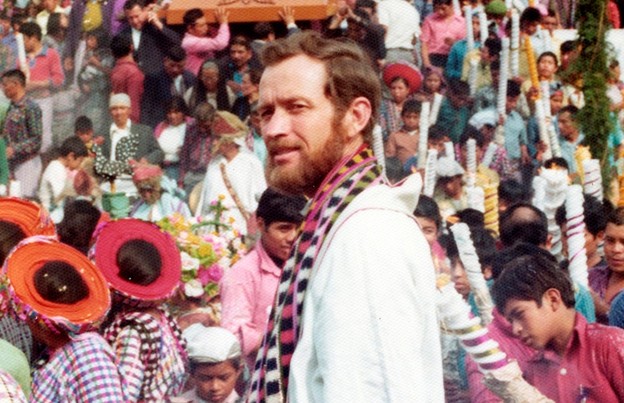
            I was the editor of The Eastern Oklahoma Catholic, at that time a bi-weekly newspaper for the Diocese of Tulsa. I worked directly for the Most Rev. Eusebius Beltran, the second Bishop of Tulsa. I was thrilled to be invited on the trip to Guatemala to chronicle the 10-year anniversary. We spent ten days in this beautiful Central American country. Our first night was in Guatemala City, the capital, in a very American-style hotel.

That night, guerrilla fighters blew up an electrical substation somewhere near the capital, and the power went out for several hours. The drawn-out civil war between the Guatemalan government and leftist guerillas had not ended and it did not bring out the best of either side. There were atrocities committed, each side blaming the other for the violence and mayhem. We were aware of this before we left the U.S. but we were assured that the country had calmed enough for us to safely visit.

Our arrival belied that assurance. Upon our arrival at the airport, we were met by young men wielding automatic rifles (machine guns), who escorted us to Customs for processing. It was unnerving, but I chalked it up to a “safety first” policy.  The explosion and power outage later that night rattled our nerves, and the newspapers in the morning, though in Spanish, left more doubts. Our group could talk of little else as we prepared to board a chartered bus after breakfast.

There were two groups of pilgrims, one from Tulsa and another led by Archbishop Charles Salatka of Oklahoma City. We would worship together in Santiago Atitlan but otherwise had parallel travel plans. The Tulsa bus took us on a “scenic route” to the resort town of Panajachel, but first we would visit Antigua, (it means antique, or old), which from 1543 to 1773 was the capital city.

Later that afternoon we would wind down the mountainous highway into Panajachel, staying at a beautiful, tranquil inn that would be our home base for several days. This was on the north side of Lake Atitlan. The following morning we took a large 45-minute ferry ride south across the lake to Santiago Atitlan.
A Land of Volcanoes

The views were enthralling. Lake Atitlan is ringed by mountains, three of them volcanoes. What’s more, the lake itself fits inside a caldera not quite a mile above sea level. It’s 1,120 feet deep – the deepest lake in Central America. It was formed 84,000 years ago when Los Chocoyos volcano erupted. Two rivers keep it filled. It’s good for fishing, and that helps provide protein for the Mayan people. Local fishermen used crude wooden john boats to ply their trade.

Upon our arrival we were swarmed by dozens of welcomers, all speaking Spanish and many eager to sell us blankets, jackets, jewelry and such. It was my first experience at “haggling” and I was not very good at it. The locals seemed disappointed with my pitiful skills.  A couple of people who had been there before attempted to instruct me in the local rules of commerce. It helped, but my American shopping reflexes (used to price tags and paying whatever the merchant demands) did not want to be easily put aside.

The first order of business was a tour of the Church of Santiago (St. James), meeting with Father Thomas McSherry, the replacement missionary priest from Oklahoma, and then the Oklahoma bishops met with the local ordinary, Bishop Eduardo Fuentes of the Diocese of Solola to plan the next day’s 10th anniversary Mass. The rest of us wandered about the city, admiring the cobblestone streets and the bustling mercantile district. I had my Pentax 35mm camera clicking non-stop.

The next day, July 28, would occasion a celebration Mass at the Church of Santiago. But before that we gathered near the rectory. The three bishops entered that special area set aside for Father Rother’s heart and were in there for several minutes.

When they emerged, the announcement was made. Father Stanley’s heart was still liquid. Pliable, lifelike.  From a scientifical point of view, quite impossible. The jar was not hermetically sealed. It was not refrigerated. There was no embalming. The heart had been fair game for bacteria and the vagaries of highland humidity for years.

The Catholic perspective on this? Father Stan Rother’s remains were exhibiting special signs of God’s grace, of sanctity. Already considered a martyr because he knew he was on a “death list” and yet refused to abandon his flock, there was now a heaven-sent affirmation of his martyrdom.

In other words, he might well be a saint.

A Brief Explanation of Sainthood

What is a saint?

If you are Christian, it’s what you dearly wish to be. A saint is someone who has attained Heaven, who lives forever in the friendship of Christ, who enjoys the “beatific vision,” and who rejoices in communion with all the other saints and angels who populate this region of God’s Kingdom. In fact, it should be your goal in life to become a saint, and to help your family members become saints.

There are countless saints. Scripture says they are beyond numbering (Revelation 7:9). They represent all those saved throughout the centuries. We don’t know most of their names.

But some are known, given as examples to inspire us and to offer help to us. The Roman Catholic Church does not make snap judgments as to who merits sainthood; in fact, it is extremely plodding in its deliberation of sainthood “causes”. There are procedures for such things and it usually takes decades for sainthood to be declared. Even with martyrdom, the Church prefers to validate a miracle or two, to establish proof that the would-be saint, with the approval of Almighty God, has interceded for someone on earth. That a miracle has taken place.

The process of naming saints is not really meant for those who have died. They already know who and what they are. Naming saints is a benefit for the living.  Stanley Rother died in 1981 and few who knew of the circumstances of his death doubted that he was in Heaven as a martyr for the faith. Consequently, his cause was taken up by many Oklahoma Catholics and, 36 years later, in 2017, he was “beatified” – a first step toward canonization.

The Church allows people to pray to Blessed Stanley, especially those in Oklahoma or who visit his official shrine in Oklahoma City. The investigation into his life, his holiness, virtues and martyrdom continue. Will Stanley Rother become a saint? It’s hard to know. There are many “blessed” named by the Church who have never been fully declared a saint. What is usually needed is a miracle or two.

This was reported by KOCO-5 News in November 2017:

One of the most widely reported miracles attributed to Blessed Stanley Rother involves Sandra McGougan, who suffered a life-threatening brain injury in 1992. At age 22, she experienced a rupture of an extra set of veins in her brain stem, leaving her unresponsive and near death. Doctors initially considered organ harvesting due to her critical condition. Her family called a priest to pray at Rother’s grave, seeking his intercession. After three days, Sandra regained consciousness and eventually recovered the ability to walk, talk, and live a normal life. Medical professionals involved declared her recovery unexplainable by science, and the case was submitted to the Vatican as evidence of a miracle.

That miracle solidified Stanley Rother’s beatification. He needs a second bonafide miracle. In 2023, Oklahoma City Archbishop Paul Coakley wrote:

“The next step in Blessed Stanley’s Cause is canonization, which would give the Church its first saint from Oklahoma! Praying for his intercession is the most important way we can help this happen. If you need a miracle in your life or in the life of someone you love, remember that Blessed Stanley needs a miracle too!”

With the release of the new movie, it’s possible that more people will be encouraged to pray for Blessed Stanley’s intercession. They will be encouraged to document these prayers and their experience with healing, if one should occur. Ultimately, it’s all up to the Will of God.

In conclusion

            We spent 10 days in Guatemala, saw several villages and cities, and came away thoroughly charmed by this rugged country. I am pleased to say that the civil war did eventually end. Santiago Atitlan is still a place of pilgrimage and, of course, tourism, but it is no longer an Oklahoma mission. Perhaps owing to the influence of Blessed Stanley Rother, the parish has been able to stand on its own, and has had a multitude of religious vocations.

            I would love to return someday, but this week I will at least go to Fort Smith to see Blessed Stanley’s documentary.

Taxing Paper Wealth

A new front has opened in class warfare

The Biden Administration is very busy. It’s hard to keep up. Once upon a time – in previous presidencies – there was an outrage of the month. The pace quickened and it was an outrage of the week, then the day. Now it is the outrage of the hour.

Sometimes it’s difficult to focus on one particular egregious policy or action, there are so many from which to choose. But two recent reports stand out. One threatens to upend the dynamic that drives American economic progress. The second stands out as a slap in the face to all who pay taxes and want to have faith in the judicial system. (I will deal with that in the next post.)

President Biden has “expressed support” for an annual tax on the unrealized capital gains of “the wealthy.” That probably sounds swell to a lot of people who have been taught to despise the wealthy (but not the wealth).  But there’s a huge problem here, as Elizabeth Dellinger of Fisher Investments explains:

… economists from the Office for Management and Budget (OMB) see it differently, apparently. Their report redefined income as the increase in wealth from one year to the next—a bizarre methodology that introduces a lot of oddities, in my view. This would be a mere academic curiosity if Congressional Democrats weren’t jawboning about taxing wealthy individuals’ unrealized capital gains as they scramble to rewrite the reconciliation budget bill.

And:

Much of the current push stems from the notion that wealthy people aren’t paying their “fair share,” which the OMB’s analysis aimed to demonstrate. It estimated “the average Federal individual income tax rate paid by America’s 400 wealthiest families, using a relatively comprehensive measure of their income that includes income from unsold stock.” (Italics mine.)

Thing is, these families are not sitting on mountains of gold coins like Scrooge McDuck. Their wealth is predominantly assets—illiquid (businesses, art) and liquid (stocks, bonds). Increases to that wealth exist on paper only. The current proposal to tax unrealized gains would include real estate, which is also quite illiquid—you can’t sell it in a minute and expect to get fair value. Nor is there a way of tracking its market value day by day. Like all illiquid assets, rising property values are one step away from imaginary.

What happens if this new tax becomes law?

First, lawsuits. Not all billionaires have under-the-table sweetheart deals with the administration, and they aren’t going to take a full-frontal assault on their wealth without fighting back. Nor should they. Leftist hopes to destroy American capitalism could be dashed against the rocks of the Constitution, but the damage to the economy would linger.

Second, changes in behavior. The uber-wealthy are smart and they employ smart people to help them cope with such insanity. They may expatriate to less greedy countries, taking their wealth – not to mention their initiative and the jobs their wealth provides – to greener pastures. The loser in this will be America. Very few jobs are created by people on food stamps. Unemployment will rise; businesses and factories will close. Few will want to invest in a market that could bring upon you catastrophic taxes.

Third, at first the law would be for the billionaire class. It would not stay that way, especially if revenues fall below expectations. Those who would grow government will not be satisfied until these taxes on “paper wealth” are extended downward. Remember your history: the original federal income tax was capped at 7 percent for those considered uber wealthy in 1913. Oh, those were the days!

Ms. Dellinger explains that

… there are two simple reasons capital gains taxes have preferred rates. One is incentivizing long-term investment, which drives job creation. The other is to account for inflation, which can offset a large chunk of long-term returns.

Inflation, which is rocketing now, is the best friend of the socialist mastermind. It provides a never-ending opportunity to “do something,” whether it is instituting new, expensive programs that dictate what people can and cannot do, or increases in taxation when “paper wealth” rises because of inflation.

You see, inflation is not a defect in the current economic situation, it is a feature. But only if you want bigger government and don’t give a damn about capital markets, free enterprise or freedom itself.

There is already too much money (much of it created digitally) chasing too few goods (some of it waiting offshore to be unloaded) which means prices rise. I expect soon to hear calls for wage and price controls, which will solve nothing.

When markets take a downturn, as they will, and the unrealized gains turn into unrealized losses, will the government offer tax credits or rebates? Hell, no! The flow from the private sector to the government is one-way only.

Understand, punishment for the rich will only punish everyone. Whether there are enough intelligent people left to comprehend this, who knows? Whether there are enough men and women in Congress with the common sense and courage to say no, we shall soon see.

Autumnal Pet Peeves

I will stay a little more on the lighter side today, but not much. This is my Autumn 2021 list of pet peeves that challenge my desire to promote peace and harmony in the world. To paraphrase Michael Stipe, “That’s me in the Tundra, losing my religion.”

Much of what is wrong with present-day America could be repaired with a bit more compassion, enhanced concern for our neighbors, and a return to basic rules of etiquette and manners. Not everything is left or right; some of it is consideration, or the lack of it. Here are five topics which, if corrected, would be a good start:

Roadside Litter.  Actually, any litter but especially the garbage thrown by thoughtless motorists.  I thought we had sufficiently educated ourselves “back in the day” but apparently not.  There is a geographical component to this unsightliness. Drive through most of Kansas and Missouri and you rarely see anything except clean highways, streets and yards. Not so much Oklahoma and Arkansas. People often chide me for trash in my back seat, where it awaits proper disposal. I don’t care. We need to have pride in our cities, towns and states.

Left Lane Lurkers.  These are drivers who either didn’t pay attention in Driver’s Ed, or they have their left and right confused. Despite frequent signs in many places that advise slower traffic to keep to the right (“keep right except to pass” is an alternative), they just don’t get it. Until, that is, you pass them on the right. Then that’s when they want to move over to your lane.

The Turn-Signal Challenged.  I was taught that you signal a turn every time you prepare to turn or change lanes. Do it often enough, it becomes second nature, you don’t have to think about it.  Every day I encounter people who apparently refuse to use their turn signals. It comes off as inconsiderate, and it’s often dangerous. Definitely not cool. If you’re too lazy to engage signals, then heaven help you if you have to stop suddenly and need your brakes. That takes real effort.

The Supermarket Conversationalists.  Pushing carts, they meet in an aisle, engage in conversation, and callously ignore all others who are trying to get through from either wide. They often glare at you if you attempt to get their attention. I’m all for face-to-face communication, but there are proper times and places. Take your talk elsewhere, people!

Drive-Through Dysfunctionality. People use drive-through lanes at restaurants to save time, or at least they used to.  Nowadays, I see people chatting on their phones, texting or social media-cavorting, paying little attention to the vehicle ahead of them, or showing any concern for those still waiting to order. There may be fifteen cars behind them, but they will not move until they are finished. This has to be frustrating to the food-service people who are trying to keep the lines moving. It sure is for those waiting behind them. For the love of all that is holy, develop some situational awareness!

A ‘Roadmap’ to what?

Last Friday, while you were winding down from a hard work week, making plans to attend a football game, or a balloon festival, or get some fall yard work done, the Biden Administration quietly released its “Roadmap to Build an Economy Resilient to Climate Change Impacts.”  Prepare for the next assault on your freedom.

As a rule, any major announcement that is done in the waning hours of a Friday is to keep it from becoming front page news. A Friday release probably wasn’t necessary, with the all-compliant corporate media willing to take a nap. But it is something you need to know about. The changes envisioned in this “Roadmap” will affect your future in very bad ways, and all built on the wobbly concept that climate change is a national security threat.

Climate change, as you should realize by now, is anything the left declares it to be. If hail pounds roofs in Weatherford, Texas, in the fall, then the climate is out of whack.  If there are places of drought, excessive rainfall, a flooded river, an errant tropical storm, or an unexpectedly delightful sunny day, all are symptoms of climate out of control.

We used to call it weather. Now, all weather is climate change, and the government is mobilizing (targeting our economy) to mitigate the damage. An excerpt:

This year alone, extreme weather has upended the U.S. economy and affected one in three Americans. Both international and domestic supply chains have been disrupted by climate change – whether it’s floods in China and Texas, or wildfires that have burned nearly six million acres of land, supply chains across critical industries including housing, construction, semiconductors, and agriculture have been affected, causing delays and shortages for both consumers and businesses.

Yeah, you read it right. The supply chain disruptions are the result of climate change. Not the imbecilic lockdowns and mandated vaccinations that are causing a great number of workers – blue and white collar alike – to risk their jobs. No, of course it’s the climate. Not the labor supply problems resulting from paying people to sit on their collective brains while the government pays them. Gotta be the climate, right?

But it gets so much better. The Biden Administration plans to make all of us snowflakes safe by protection our investments by inserting new rules as to where investments can be made, and where they can’t.  Excerpt No. 2:

Climate-related risks hidden in workers’ retirement plans have already cost American retirees billions in lost pension dollars. Climate change poses a systemic risk to our economy and our financial system, and we must take decisive action to mitigate its impacts.  By addressing the costs of the climate crisis head-on, the federal government will safeguard the life savings of workers and families, spur the creation of good-paying, union jobs, and ensure the long-term sustainability of U.S. economic prosperity. The roadmap makes clear that protecting the financial health of American households, deploying clean energy in United States, and building an economy from the bottom-up and the middle-out go hand-in-hand. 

The plan is to act in unison with some of the largest banks and lenders, through the US Treasury Department, USDA, HUD and Veterans Administration, among others, to impose a new code of conduct for investments, whether we like it or not.

Question No. 1 – Do we trust this gang that couldn’t handle the withdrawal from Afghanistan to lay hands on the American economy?  (I would argue that the damage the Biden Administration has already inflicted is breath-taking in its economic ignorance.)

Question No. 2 – Doesn’t this “public-private partnership” play bloody hell with individual freedom?

Excerpt No. 3:

This week, the Department of Labor announced it is proposing a rule that protects workers’ hard-earned life savings by making clear that investment managers can consider climate change and other ESG factors in making investment decisions. The proposed rule – which, if finalized, would help safeguard the more than half of American workers who participate in a retirement plan through their job, representing over 140 million Americans and more than $12 trillion in retirement savings and pensions – would protect workers by making sure that retirement managers don’t turn a blind eye to climate risks and other important factors. It would also make clear that retirement managers can take important environmental, social, and governance factors into account when making investment decisions, so that workers can share in the gains that come from sustainable investments.

Ah, yes, the ESG scores. ESG stands for Environmental, Social and Governance. This is why the government wants to monitor all bank accounts for transactions over $600. The left wants to know how you spend your money. If you don’t buy an electric car, if you don’t give to leftist causes or if you believe in the Sanctity of Life, and you contribute money to conservative political candidates, then your ESG score will drop like a big rock and you may be forbidden to take out loans for things like, oh, houses and such.

This is all part of the Great Reset that the global elites have determined must take place so that we can all be equally miserable in the coming New World Order.

Yes, I know that it sounds a bit nutty, but read the document for yourself. Do a little bit of research that doesn’t come through the mind-masters of social media, and educate yourself before they ram this stuff over all of us. Expect the propaganda machine to go into high gear, and Facebook factcheckers to clamp down on any “discouraging words” that question the wisdom from on high.

Let’s go, Brandon!